

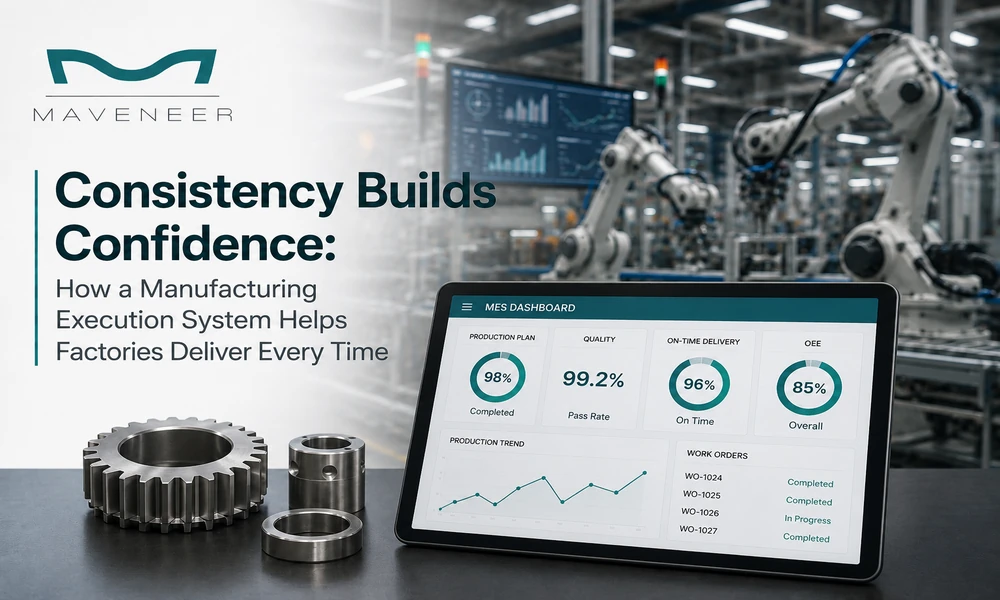
Customers may never know what happens inside a factory but they only see the end result. They expect every product, made yesterday or six months ago, to meet the same quality standards. That consistency is hard to deliver, especially over production that spanned multiple machines, operators, and processes.
This is where a manufacturing execution system (MES) comes in. It can help manufacturers congratulate with standardizing production to reduce variance and ensure that every section of the operation is synced towards achieving a common goal.
Each Production Batch Has a Story to Tell
It’s not a production day where two concocted days. You could get a different raw material from a different supplier; machine settings can alter or production teams can start to run shifts one after the other.
This means these little variances are going to affect product quality in absence of a process.
A manufacturing execution system tracks production activity in real time, which facilitates adherence to approved processes and also indicates where alternatives may be acceptable. Manufacturers maintain accurate production records that support repeatable results − not relying on memory or written notes.
Goals for Minimizing Variations on the Production Floor
The smallest set-back leads to bigger things later in the future. One slight discrepancy in either the temperature during production or an errant machine setting could lead to wasted materials or rejected goods.
A manufacturing execution system is designed to help production teams track relevant manufacturing data and adhere more closely to standard operating procedures. This helps in lessening unnecessary variation and increases confidence that every batch passes the specifications.
Often consistency is a process, not complicated tech.
Helping Teams Stay Aligned
Manufacturing is a team effort. Everyone from production operators, supervisors to maintenance staff, and quality inspectors plays their part in the final product.
Communication is much easier when we feel clear since everyone is working off the same information.
A few practical advantages consist of:
- Standardized production instructions
- Accurate production records
- Better communication between departments
- Faster reporting of production issues
- Improved quality inspections
- Reduced reliance on manual paperwork
Such improvements help in smooth running and reduce misunderstanding on day to day basis.
The Commonsense Data You Need to Fix the Problems Easier
Production complexity, of course, can’t be completely eliminated but accurate information allows you to address these problems more effectively.
In case a defect happens, manufacturing execution systems allow managers to access production history, search for the affected batches, and check for possible causes. Rather than sifting through paper files, they can find production particulars in a fraction of the time.
This helps reduce time to investigation, and enables quicker correction.
Preparing for Long-Term Growth
With the scaling of factories, quality control becomes increasingly demanding. More equipment, more staff, and increased production volumes create a demand for process.
The visibility and control around that growth is afforded to manufacturers by a scalable manufacturing execution system. It aids compliance to production standards, while also enabling the introduction of new products and responding to changing demand from consumers.
Strong Processes Create Better Products
Manufacturing that you can trust is based on consistency, not luck. A great manufacturing execution system helps companies to stay on the floor with production standards, communication, as well as record retention at every level of manufacturing. It allows factories to produce better products under their assumption of production rate or operational complexity with less variation and helps decision makers make informed decisions.
