

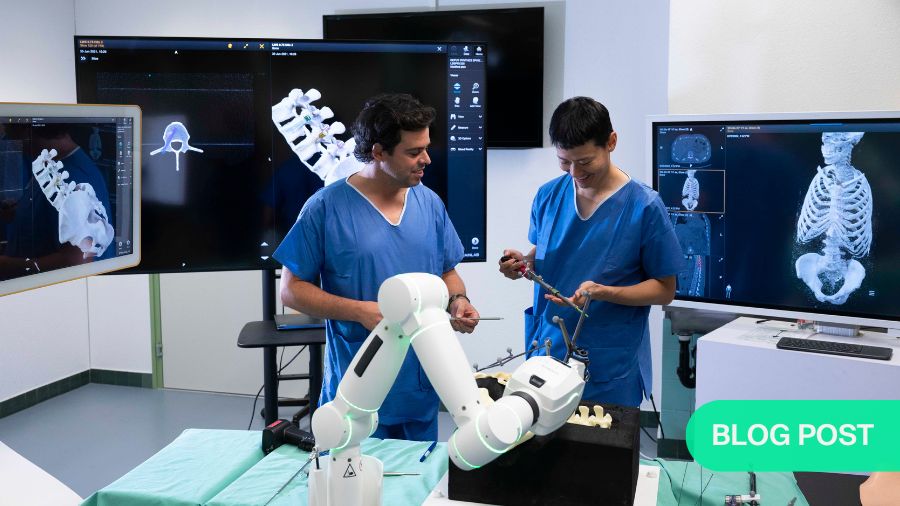
Spinal surgeries for deformities or multi-level repairs rank among the most challenging procedures in modern medicine. They require precise work across multiple vertebrae and careful alignment, to maintain both function and stability. Robotics has become a valuable tool in managing these complex cases. Dr. Larry Davidson, a leading expert in minimally invasive spinal surgery, notes that robotic platforms enable surgeons to achieve precision and consistency across long constructs, allowing even the most intricate corrections to be performed safely.
By providing millimeter-level accuracy and real-time guidance, robotics reduces the risks that once made multi-level and deformity surgeries highly unpredictable. The result is greater stability, fewer complications and more predictable recoveries for patients with complex spinal needs.
The Challenges of Complex Spinal Surgery
Multi-level repairs and deformity corrections, such as scoliosis or kyphosis, require extensive instrumentation. Dozens of screws and rods must be placed in alignment across multiple vertebrae. Even small errors in one segment can magnify down the construct, compromising balance and stability.
Traditional techniques rely heavily on anatomical landmarks and the surgeon’s experience. While effective, these approaches leave room for variability, especially in patients with distorted anatomy or osteoporosis. Robotics addresses these challenges by standardizing accuracy across every level.
Planning Across Multiple Levels
Robotic systems begin with advanced imaging, often CT scans, which are uploaded into planning software. Surgeons map out screw trajectories and alignment goals across the entire construct before surgery begins. This planning allows for precise coordination across multiple vertebrae.
During surgery, the robot guides instruments along the preoperative plan, maintaining consistent placement from the first screw to the last. This capacity to replicate precise accuracy across numerous placements is a key advantage of robotics in complex cases.
Precision in Deformity Correction
Deformity surgeries often involve distorted anatomy, where traditional landmarks are less reliable. Robotics provides a digital roadmap based on imaging, allowing screws and rods to be placed safely despite abnormal spinal curves.
Dr. Larry Davidson says, “Combining advanced robotic tools with surgical expertise elevates patient care, by making procedures safer and recovery more manageable.” His insight reflects the very heart of complex spine surgery, where the combination of advanced technology and surgeon skill makes durable corrections possible, in even the most challenging cases.
This level of accuracy helps achieve the intended alignment, while preserving spinal stability. By minimizing variability, robotics enhance the durability of deformity repairs, supporting long-term spinal balance. It offers added confidence in cases where manual placement carries higher risks, and the combination of precise planning and execution transforms outcomes for patients with severe deformities.
Benefits for Patients
For patients, robotic assistance translates into safer surgeries and smoother recoveries. Accurate alignment reduces pain and improves mobility, while smaller incisions associated with robotic guided, minimally invasive techniques shorten recovery times. The consistency robotics provides also reduces complication risks, such as nerve injury or hardware misplacement. Patients can proceed through rehabilitation with greater confidence that their spine is stable and properly corrected.
Robotics in Osteoporotic and Fragile Bone
Patients with osteoporosis add extra complexity to spinal surgery, as fragile bone raises the risk of screw loosening or pullout. Robotics enhances fixation, by optimizing screw trajectories and targeting the strongest available bone. By strengthening stability in these patients, robotics lowers the risk of failure and improves outcomes for multi-level constructs. This precision broadens surgical options for patients who might otherwise have limited treatment choices.
Efficiency in Complex Procedures
Complex spinal surgeries often take many hours, increasing risks associated with anesthesia, blood loss and fatigue. Robotics improves efficiency, by reducing trial-and-error in hardware placement. Preplanned trajectories minimize intraoperative adjustments, shortening overall operative time. Shorter surgeries benefit both patients and healthcare systems, by lowering complication risks and reducing costs. In lengthy deformity or multi-level cases, efficiency is just as valuable as accuracy.
Athletes and Complex Spinal Cases
Athletes with complex spinal conditions, whether from trauma or deformity, face unique recovery challenges. Robotics ensures that corrections are precise and durable enough to support high levels of physical stress. Robotic assistance allows athletes to return to training and performance more safely, by reducing recovery times and minimizing complications. The balance of accuracy and efficiency is especially critical for this group, whose careers depend on spinal health.
Training Surgeons in Complex Robotic Cases
As robotics takes a central role in complex spinal surgery, training programs are evolving. Surgeons now learn to incorporate robotic systems into multi-level and deformity cases, gaining hands-on experience in simulation labs, before applying these techniques in the operating room.
Mentorship continues to be essential. While robotics improves accuracy, the surgeon’s judgment in planning and execution remains critical. Guiding younger surgeons to balance technology with clinical decision-making helps keep patient outcomes at the forefront.
Advances on the Horizon
The future of robotics in complex spinal surgery is advancing quickly. Integration with AI could enable robots to adapt plans in real time, as anatomy shifts during procedures. Improved imaging will provide continuous updates, maintaining precision, even under changing conditions. Smaller, more versatile robotic systems will broaden access, allowing more hospitals to perform complex robotic-assisted surgeries. These innovations promise to enhance both safety and outcomes, for patients with deformities or multi-level spinal needs.
Patients as Partners in Complex Care
Patients are integral to the success of complex spinal surgeries. Learning about the benefits and limitations of robotics supports informed consent and builds trust. When patients understand how robotics contributes to safety and recovery, they engage more actively in rehabilitation and follow-up care. This collaboration emphasizes that robotics is a tool to enhance, not replace, the surgeon’s expertise.
Robotics is redefining what is possible in complex spinal surgery. By delivering consistent accuracy across multiple levels and distorted anatomy, it reduces complications and improves long-term stability. As technology advances, its role in managing deformities and multi-level repairs will only grow. It means safer surgeries and stronger recoveries for patients. For surgeons, robotics provides the tools needed to manage complexity confidently.
Complex spinal surgeries once carried high risks due to the challenges of alignment, stability and distorted anatomy. Robotics now provides the precision and consistency needed to overcome these barriers, making multi-level repairs and deformity corrections safer and more effective. The perspective underscores that robotics is not simply about advanced technology, but is about achieving outcomes that restore function and independence. This work demonstrates that in the most complex cases, precision can determine success or setback, and robotics helps achieve that level of accuracy.
